CBD vs THC for Muscle Recovery: What Works Best?
Somebody walks up to our counter all the time, moving a little stiff, and asks the same question: CBD or THC?
Fair question, folks. If you've searched muscle pain cannabis, cannabis for pain relief or just typed "CBD or THC" into your phone at midnight, you're staring at a wall of recovery balms, CBD drops, 1:1 gummies and indica pre-rolls, all promising to sort out your sore muscles.
It's a lot. We get it.
The straight answer? There's no single winner.
CBD and THC work differently in the body, they feel different, and they fit different parts of your day. The right pick depends on what you want out of it, how you take it, how much cannabis you're used to, and whether you've still got places to be.
This is our no-nonsense guide to CBD vs THC for recovery, from how each one works to picking a product off the Stok'd Niagara Falls menu.
If you want more information about athletic recovery, check out our wellness series about Active Recovery below:
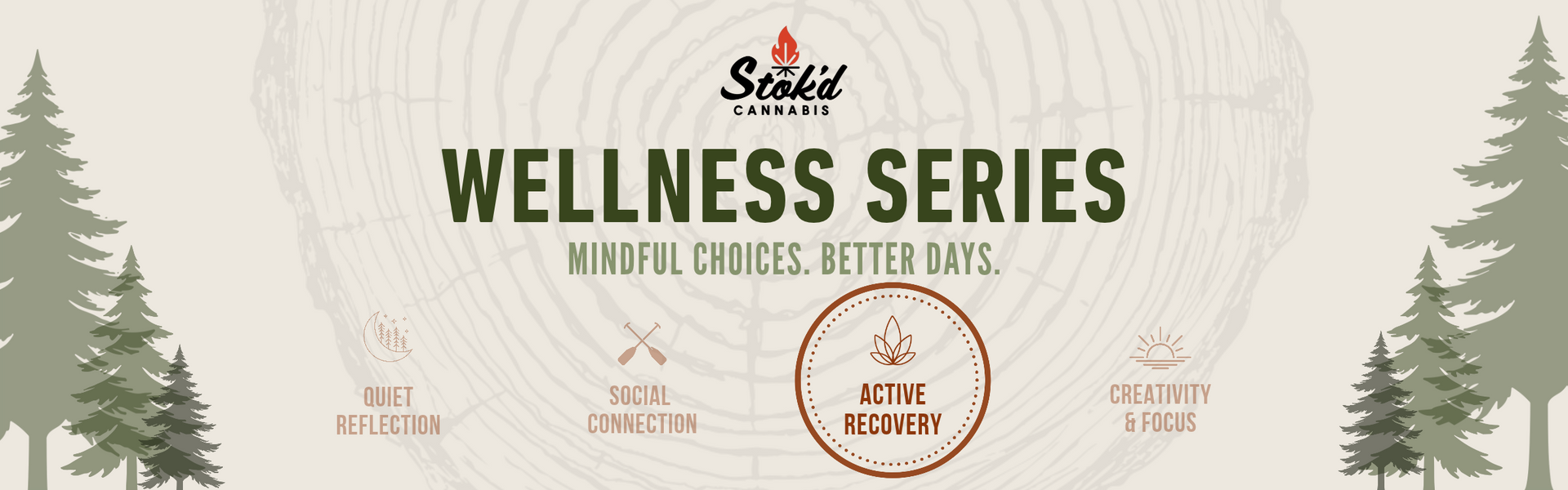
If you want to see more topics we cover for overall wellness, check out our Wellness Series here.
What CBD Does for Muscle Recovery
CBD, short for cannabidiol, is the one that won't get you high. It works with your endocannabinoid system, the network of receptors and messengers that helps keep things like pain, mood and inflammation in check throughout your body.
CBD works through several pathways in the body, including ones researchers link to inflammation. That's why so much of the buzz around CBD for muscle recovery is about inflammation, and why people shopping for cannabis for inflammation usually start with CBD, though the research is still early. And because CBD doesn't get you high, you can use it and still go about your day.
People tell us they reach for CBD:
- After a workout, to take the edge off sore muscles
- During a week of back-to-back training
- During the day, when they need a clear head for work, driving or chasing kids
- Alongside stretching, foam rolling or braving an ice bath
- As a gentle nudge toward better sleep
Real talk. The effects of CBD for muscle recovery are subtle. Most people describe it as taking the edge off, and if you're weighing CBD vs THC, that's the trade you make for staying sharp. You'll find CBD topicals, oils and capsules in our ingested extracts and topicals.
What THC Does for Muscle Recovery
THC, short for tetrahydrocannabinol, is the one that can get you high. Key word: can. It binds mainly to CB1 receptors in your brain and nervous system, and how you take it decides whether it gets there.
Eat, smoke or vape it, and THC reaches your brain, which is where the high comes from. Rub it in as a standard topical and it stays put, so it won't get you high. A bath bomb blended with THC, CBD and CBG is unlikely to either. That's why a 1:1 relief stick or a cannabinoid soak can feel wonderfully relaxing on sore muscles without changing what's going on upstairs. Transdermal patches are the exception, since they're built to reach your bloodstream, so read the label.
This is where THC for muscle pain gets interesting. People tell us THC changes how much the ache bugs them. The soreness is still there, but it stops running the show. THC is also a longtime favourite for relaxing and sleeping, and plenty of people say it helps tight, knotted-up muscles let go.
Eaten, vaped or smoked, THC for muscle pain fits best in down times, when soreness is keeping you up or full relaxation is the plan, and the high is part of the fun for a lot of people. As a topical or a bath soak, it fits anytime.
Now for the grownup part. Eaten, smoked or vaped, THC is intoxicating, so no driving or operating anything heavier than a remote. Tolerance builds if you use it a lot, so the same dose can feel weaker over time. Most folks save edibles, oils and pre-rolls for when the day's done, which is exactly what our Active Recovery collection is built around.
How CBD and THC Work Differently
Here's the difference between CBD and THC for recovery, side by side. If you only read one section on CBD vs THC for recovery, make it this one.
| CBD | THC | |
|---|---|---|
| Gets you high? | Nope | Eaten, smoked or vaped, yes. As a standard topical, no |
| Main focus | Inflammation | How pain feels |
| Time of day | Anytime, including work hours | Evening, or anytime as a topical |
| How it feels | Subtle | You'll notice |
| Around activity | Before, during or after | After you're done, unless it's a topical |
| For beginners | An easy starting point | Start low, go slow |
Both can help with sleep and tight muscles, blend together in ratios and come in just about every format.
The easiest way to remember it?
- CBD is the one people reach for when inflammation is the focus.
- THC changes how you feel the pain.
Both are legit. They just take different roads to get there.
CBD:THC Ratios Explained
Ratios are where CBD vs THC for recovery stops being an either/or question. Plenty of recovery products blend the two, and the ratio on the label tells you the mix.
- 1:1 is equal parts CBD and THC.
- 2:1 is twice as much CBD as THC.
- 20:1 is mostly CBD with a whisper of THC.
- 1:0 is CBD only, no THC at all.
More CBD in the mix means less of a high. More THC means more pain relief and, in edibles, oils and pre-rolls, more of a high. In a topical or a bath bomb, the ratio changes how it feels on your muscles and leaves your head alone. Balanced ratios like 1:1 give you a bit of both. A lot of people believe even a trace of THC helps CBD do its thing, an idea called the entourage effect, though the science is still catching up.
Picking a CBD THC ratio for pain and soreness? New folks start at 20:1 or CBD only. Lean CBD-dominant by day, and save balanced or THC-dominant for the evening.
Which One Should You Choose?
So which is better, CBD or THC, for muscles? And what's the best cannabinoid for muscle soreness? Depends on you. This is how we'd walk a friend through it. It's general guidance, not medical advice.
Choose CBD for muscle recovery if:
- You need to stay on your game for work, driving or parenting
- You're new to cannabis
- You're focused on inflammation
- You want relief without any buzz
- You get drug tested. Check whether a CBD product is full-spectrum, which contains trace THC, or isolate, which doesn't.
Choose THC for muscle pain if:
- You're using it in the evening
- Soreness is wrecking your sleep
- You already know your tolerance
- You're comfortable feeling high when you eat or smoke it
- You want your muscles to fully let go.
Want both? A combination product gives you a bit of each.
And if you want THC and CBD working on sore muscles without the high, a 1:1 topical or a cannabinoid bath bomb is the way in.
Brand new? Start here:
- Try a topical. CBD-only is the easiest start, and a 1:1 topical won't get you high either.
- If it helps but doesn't quite cut it, try a low-dose CBD oil or capsule.
- Still not enough? Step up to a high-CBD ratio like 20:1 or 10:1.
- Work up to balanced or THC-dominant products only if you need to.
Browse the Active Recovery collection or our topicals to find your starting point.
Best Formats for CBD and THC Recovery Products
Most muscle pain cannabis products fall into four formats.
Topicals and bath bombs come in CBD, THC or combo versions and stay local, so they're the easy daytime pick. Most people feel topicals in 15 to 30 minutes. Bath bombs live at our Malvern shop in Scarborough, and our Cannabis Topicals Guide has the full how-to.
Edibles come in every ratio and hit your whole body. They take 30 minutes to 2 hours to kick in, and the effects can last well into the next day, so pop one when you get home.
Tinctures and oils come in every ratio, kick in faster than edibles for many people and are easy to measure.
Pre-rolls and vapes are the fastest, working within minutes. They're mostly THC-dominant and a classic wind-down on the back deck after a big hike.
Products at Stok'd for Muscle Recovery
Here are six muscle pain cannabis products from the Stok'd Niagara Falls menu, running from CBD-only to THC-dominant, whether you want CBD for muscle recovery, THC or both.
Wildflower | CBD Extra Strength Relief Stick | 1000mg
CBD only, with arnica, wintergreen, peppermint and eucalyptus in a stick you rub right onto sore muscles. Great for beginners and daytime, with that hockey dressing room smell.
Wildflower | Extra Strength 1:1 Relief Stick | 1000mg
1:1, with 500mg of CBD and 500mg of THC. It stays local and won't get you high, so you can put THC and CBD to work on a stubborn spot any time of day.
ufeelu | Relief Drops | 1200mg
CBD and CBC, no THC. A sunflower oil tincture with 30mg of CBD and 10mg of CBC per ml and a sunny citrus-tropical terp blend. Good for anyone who likes knowing exactly how much they're taking.
Redecan | CBD Gems | 15 Capsules
About 10:1, with up to 10mg of CBD and 1mg of THC per capsule. Grown right here in Niagara, and a no-mess next step if you want a hint of THC.
Chowie Wowie | Peanut Butter Balanced Chocolate | 1x10mg
1:1, with 10mg of THC and 10mg of CBD in a peanut butter milk chocolate bar that's meant to be shared. Or not. We won't tell.
HighXotic | Royal Ace #1: Black Mountain Side Pre-Roll | 14x0.5g
THC-dominant, indica-dominant pre-rolls from a Durban Poison x OG Kush cross. The THC runs high, so these are for experienced consumers ready to call it a night. Old heads, you know what to do.
Heading out for a big day on the trail? We've got a list of what to pack after hiking the Niagara Glen.
Wrapping Up
CBD is the go-to when inflammation is the focus. THC changes how you feel the pain. Rub either one into sore muscles and neither will get you high. The right call on CBD vs THC for recovery comes down to your goals, your tolerance and the time of day, so start with CBD if you're new and see what your body likes.
Browse CBD and THC recovery products at Stok'd, or swing by Stok'd Niagara Falls on Stanley Ave and talk ratios and formats with a budtender. There's no such thing as a dumb question at our counter.
Stay Stok'd.
FAQ
Is CBD or THC better for muscle recovery?
Neither CBD nor THC is better for muscle recovery across the board. People reach for CBD when they want to stay clear-headed and THC when they want help relaxing or sleeping. The right one depends on your goals and your tolerance.
Can you use CBD and THC together for recovery?
You can absolutely use CBD and THC together for recovery. Combination products like 1:1 or 2:1 give you some of each, so start low if they're new to you.
Will CBD get you high?
CBD won't get you high. It's non-intoxicating, and THC is the one that does that.
How much CBD should I use for muscle soreness?
For muscle soreness, start with the lowest dose on the label and work up from there. With edibles, wait at least 2 hours before taking more. Seriously.
Can I use THC products during the day?
Eaten, smoked or vaped, THC gets you high and impairs driving, so save those for after you're done for the day. Standard THC topicals stay local and won't get you high, so a 1:1 relief stick works fine during the day.
What's the entourage effect?
The entourage effect is the idea that CBD, THC and terpenes can boost each other when they team up. A trace of THC may help CBD work better, and CBD may take the edge off THC's high, though results vary and the science is still catching up.
Quick compliance note (because we're grownups): All products sold by Stok'd are legal and lab-tested. THC and CBD content varies by lot, and not all products are available at all locations or always in stock. Age verification (19+) and valid ID required for purchase and delivery. Nothing here is medical advice.
Recent Posts