


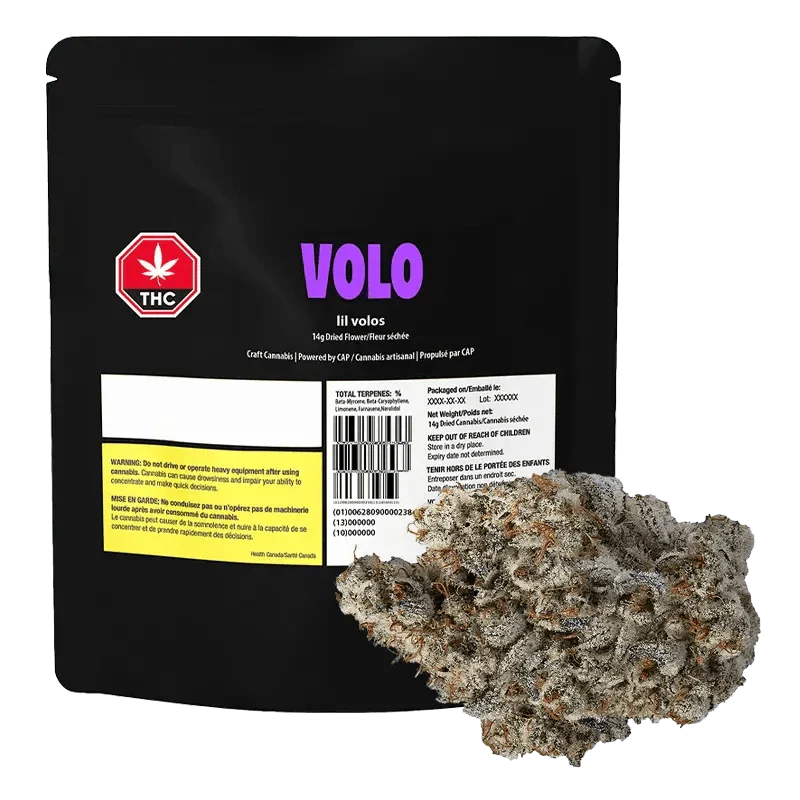
Fly First Class With Volo
Who They Are
Volo Cannabis a Southwestern Ontario licensed producer, powered by world class genetics:
“We are in the garden every day. Smelling the plants. Touching them. Tasting them. Smoking them. We compare the process to being a chef, using our lifetime of knowledge to have created a new recipe. To have something that no one else has is exciting. That’s everything to VOLO…Right from the beginning, Volo wanted to bring Canadian smokers only the best. We never fly economy and neither should you. So we did our homework. And there, at the Emerald Cup in 2021, we saw a beacon in the fog. Capulator Genetics. They had the flower we were looking for. And a partnership was born.”
What They Do
One of the few Ontario growers putting out fire to match what we’re used to seeing out west: “All of our top-shelf flowers were bred, pheno-hunted and cultivated using Capulator Genetics. Cap has a true legendary reputation for producing quads, and settles for nothing less than absurdly good cannabis.”
Why They Do It
Volo checks all the craft boxes: small batch, hang dried, hand trimmed etc. But where they truly excel is in strain selection. Passionate and obsessive about pheno selection is what really has them stand out:
“We don’t use marker-assisted breeding. The science is cool, but it’s like being on autopilot. Seed selection is based on experience we get from the plants. If you get too big you lose the essence of the art. You can’t know 1,000 phenotypes on a large scale.”
Key Products
Volo keeps it simple and sizzling with a quality yet limited selection of 3.5g jars of pure, craft fire cannabis.
Cap Junky X Jealousy
Uber chill vibes, high THC and terpenes values
What Volo says:
“Cap teamed up with Seed Junky, another LA heavyweight and award-winning breeder, to create a new cultivar with an amazing pedigree. (Leafly named Jealousy the strain on the year for 2022.) Both terps and THC are outrageously good. This flower is ready to soar.”
What Reddit says:
“So is this better than BLKMKTs? Just based on the flower it’s close but I think if I had to chose [sic] an ounce between either of them I’d choose Volos because of its brighter flavours…”
What Stok’d says: Come by our stores or order online delivery because we charge less 🙂
Mac V2
Another chiller but with a touch more thriller. Part of this most excellent lineage is a type of cookie that rhymes with Curl Slide that we can’t name.
What Volo says:
“This is the legend reimagined, with terps and THC at absurdly good percentages. Leafly voted MAC V2 one of the top 10 cannabis strains of 2022. We think you’ll agree.”
What Reddit says:
“I had to try it for myself, and I’m ???? truly glad I did. This stuff is pretty killer all around so far… I get that little bit of chocolate/ gassy smell in there. It’s not overly strong though, I can’t explain the taste either. It’s good but I truly thought it would be a bit more tasteful. ????♂️.. it’s fresh, burns clean, and is damn fricken smooth.”
Melts
A balance of chill and thrill, high potency and big smells. This is one strain that does what its name suggests ????
What Volo says:
“New strain bred and phenotype hunted by Capulator himself. High potency and strong terpenes. Has the nose of a creamy cap junky and MAC.”
What Reddit says:
“A mix of medium and small sized bud, the structure is long and wispy but dense and a bit drier on the smaller buds. Ground alright and had some stick when rolled. Smell when the jar opened was muted cannabis and sweet tea. Gound up the smell came forward with the same tea cannabis but with some cream and Arizona green tea sweetness. Smoke is smooth, light taste of savory [sic] cannabis. High starts as a head pressure, you lose mental focus. An all over tingle and slower breathing makes the high feel more mellow and you become lethargic and heavy, distracted and not caring with a side of slight mouth breathing. This is also listed as an Indica and feels like it, nice long high and dozy burnout.”
To Shop For Volo Products and So Much More, Click Here
How Canadian Provincial Casino Regulations Affect Cross-Border Play, According to Casimatic
Canada’s approach to gambling regulation is unlike most federal systems in the world. Rather than establishing a single national framework, the Canadian Criminal Code delegates authority over gaming to individual provinces, a structure that has been in place since 1969 when the federal government first amended the Code to permit provinces to license and operate lotteries. This decentralized model has produced a patchwork of regulatory environments that vary significantly from British Columbia to Ontario to Quebec — and those differences carry real consequences for players who cross provincial borders, either physically or digitally. Understanding how these provincial boundaries interact with player behavior, licensing conditions, and operator obligations is essential for anyone trying to make sense of the Canadian online gambling landscape in 2024 and beyond.
The Provincial Licensing Framework and Its Territorial Limits
Each province in Canada operates its own gaming authority, and these bodies issue licenses that are explicitly territorial in scope. The British Columbia Lottery Corporation (BCLC) governs gaming within BC under the Gaming Control Act, while the Alcohol and Gaming Commission of Ontario (AGCO) administers iGaming Ontario, which launched its regulated private-operator market in April 2022. The Régie des alcools, des courses et des jeux (RACJ) oversees Quebec’s gaming environment, and similar bodies exist in Alberta, Manitoba, and the Atlantic provinces.
The critical legal point is that a license issued by one provincial authority does not confer the right to operate in another province. When iGaming Ontario opened its framework to private operators, it required that those operators ring-fence Ontario players into a separate player pool from their international operations. This means an operator licensed under iGaming Ontario cannot legally apply the same account terms, bonus structures, or even game libraries to a player who has relocated to Quebec or Alberta. The segmentation is not merely administrative — it reflects the underlying criminal law exemption that allows provincial gaming in the first place. Operating outside the licensed jurisdiction risks losing that criminal law protection entirely.
This territorial rigidity creates a situation where a player who moves from Ontario to British Columbia may find that their existing account with an Ontario-licensed operator is no longer accessible under the same terms, or may be suspended pending verification of the new province of residence. Some operators handle this by maintaining separate regulated presences in multiple provinces, but that requires distinct licensing agreements, separate technical integrations, and compliance with each province’s specific responsible gambling mandates — a significant operational burden that not all operators are willing to absorb.
Cross-Border Play: Where the Gaps Emerge
The gaps in provincial coverage become most visible when examining provinces that have not yet launched regulated private-operator markets. As of 2024, only Ontario has opened its market to privately licensed online casino operators under a formal iGaming framework. Other provinces either operate through a government-run monopoly model — such as PlayNow.com in BC and Manitoba — or have not established a formal online casino licensing regime at all. This means that residents of provinces like Alberta, Saskatchewan, or Nova Scotia who wish to access private online casino platforms are technically doing so outside any provincially licensed structure.
The practical consequence is that players in unregulated provinces often turn to offshore operators, which are licensed in jurisdictions like Malta, Gibraltar, or Kahnawake. These operators are not illegal for individual players to use under current Canadian law — the Criminal Code targets operators, not individual bettors — but they operate without the consumer protections that a provincial framework would provide. There are no mandated self-exclusion integrations with provincial programs like Ontario’s GameSense or BC’s GameBreak, no local dispute resolution mechanisms, and no requirements to contribute to provincial problem gambling funds.
Casimatic, which analyzes regulatory developments and operator compliance across Canadian markets, has noted that this regulatory asymmetry creates an uneven playing field for consumer protection. Players in Ontario benefit from AGCO’s Standards for Internet Gaming, which include requirements around advertising, responsible gambling tools, and game integrity, while players in neighboring provinces accessing the same operators through offshore licenses receive none of those protections. Researchers and policy analysts tracking this issue can find comparative regulatory data compiled on this page, where the distinctions between provincial frameworks are documented in detail alongside operator compliance records.
The Kahnawake Gaming Commission, based in the Mohawk Territory of Kahnawake in Quebec, adds another layer of complexity. It has been issuing online gaming licenses since 1999 and has historically served as a licensing option for operators targeting Canadian players. However, its legal standing in relation to provincial law has always been ambiguous, and the Commission itself acknowledged in 2022 that it would begin transitioning away from issuing new licenses to operators primarily targeting Canadian players, partly in response to the evolving provincial landscape.
Ontario’s Regulated Market as a Case Study in Jurisdictional Friction
Ontario’s iGaming framework, administered through iGaming Ontario — a subsidiary of the Ontario Lottery and Gaming Corporation — is the most developed private-operator regime in the country and serves as a useful case study for how jurisdictional friction manifests in practice. Since the market launched in April 2022, over 70 operators have registered under the framework, and the market generated more than $2.4 billion in gross gaming revenue in its first full fiscal year, according to iGaming Ontario’s published reports.
One of the more technically demanding requirements of the Ontario framework is the player account segmentation rule. Operators must ensure that Ontario players are playing in a pool that is separate from international players, which affects game availability, jackpot sizes on networked progressive slots, and poker liquidity. For operators running global poker networks, this has been a significant technical and commercial challenge. Some operators chose not to enter the Ontario market specifically because of the liquidity fragmentation it would impose on their poker products.
The AGCO’s Standards also impose specific requirements around responsible gambling features that go beyond what many offshore jurisdictions mandate. These include mandatory deposit limit prompts at account registration, reality check notifications during play sessions, and integration with the national self-exclusion registry. When a player who has self-excluded through Ontario’s system attempts to access an Ontario-licensed operator, the system is required to block that access. No such requirement exists for offshore operators serving players in other provinces, which is a gap that provincial health advocates have consistently highlighted in public consultations.
Casimatic has tracked how these Ontario-specific requirements have influenced operator behavior more broadly, observing that some operators have begun voluntarily implementing similar responsible gambling standards in markets where they are not yet legally required, partly in anticipation of regulatory expansion and partly in response to reputational considerations. Whether other provinces will eventually adopt frameworks similar to Ontario’s remains an open question, with Alberta having conducted public consultations on a potential regulated market model but not yet moving to implementation as of mid-2024.
What Cross-Provincial Players Should Understand About Their Legal Standing
For individual players, the regulatory complexity translates into practical uncertainties that are worth understanding clearly. A player who is a resident of Ontario and holds a verified account with an iGaming Ontario-registered operator is playing within a fully regulated framework. Their funds are subject to operator obligations around segregation, their disputes can be escalated to the AGCO, and their self-exclusion choices are enforceable. If that same player travels to Alberta and attempts to log in to their Ontario-registered account, the operator may restrict access based on geolocation, since the operator’s Ontario license does not extend to Alberta and the operator may not hold a separate Alberta authorization.
Conversely, a player resident in Alberta who accesses an offshore-licensed operator is not committing an offense under Canadian law as it currently stands, but they are also not protected by any provincial regulatory framework. Their recourse in the event of a dispute is limited to whatever internal complaints process the operator offers and, in some cases, the dispute resolution mechanisms of the offshore licensing authority — which may be slow, geographically distant, and difficult to access practically.
Casimatic’s analysis of cross-provincial play patterns suggests that many Canadian players are unaware of these distinctions, often assuming that any operator accessible from a Canadian IP address and accepting Canadian dollars is operating under some form of Canadian regulatory oversight. This assumption is frequently incorrect, and the gap between player perception and regulatory reality is one of the more persistent challenges for provincial gaming authorities trying to drive players toward regulated options.
The evolution of Canadian provincial casino regulation is ongoing, and the decisions made by provinces like Alberta, Quebec, and British Columbia over the next several years will determine whether Canada moves toward a more harmonized national framework or continues to develop as a collection of distinct, sometimes incompatible regulatory environments. For players, operators, and researchers alike, keeping pace with these developments requires close attention to the specific legal and technical details of each provincial regime — details that shift as new operators enter markets, new standards are issued, and new provinces consider whether to follow Ontario’s example.


