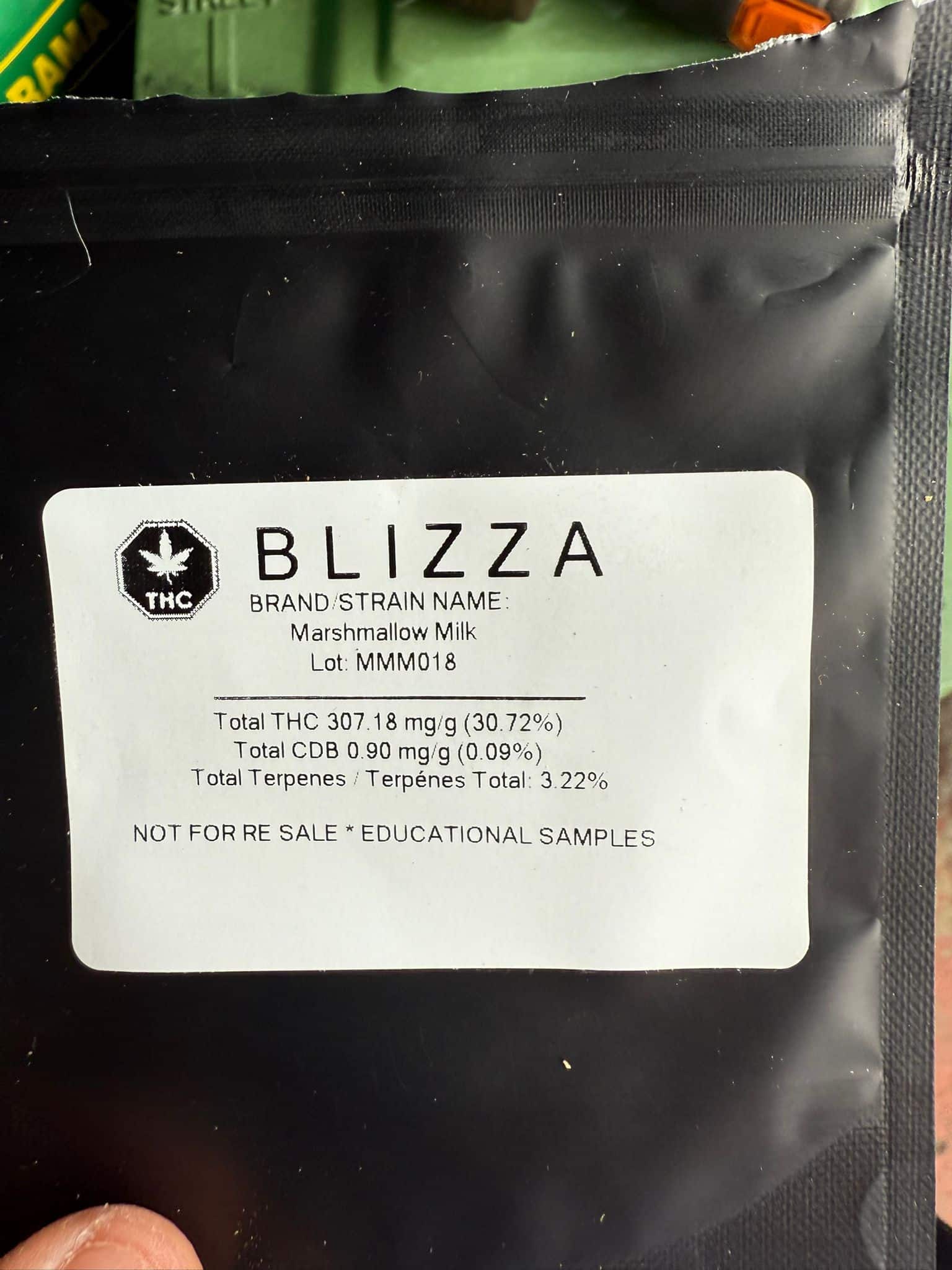
“Just grabbed the 14g of Marshmallow Milk and wow it came out of the jar in one dense sticky nug coated in crystals the smell is a amazing creamy vanilla with a hint of sweet gas super smooth to roll honestly even someone who’s never rolled before could handle this batch with ease it’s that fluffy and easy to work with as for the smoke itself absolute fire smooth on the inhale with sweet dessert like flavour and a gassy exhale the high hits mellow but heavy super relaxing with a happy head buzz and amazing body high definitely grabbing this again and it’s on sale too!!!”
Light it up, and the flavour profile immediately sets it apart—sweet, creamy undertones paired with a silky smooth inhale. It’s not aggressively loud, but that mellow sweetness sticks around, and the lack of harshness makes it one of the smoothest smoking flowers we’ve seen in rotation.
The effects kick in quickly—ideal for anyone seeking fast relief or wind-down without waiting half an hour. The high is strong but pleasant, giving you the classic Volo clarity with a calm body buzz. Even in a half-asleep state (as this reviewer admitted), the high came through clean and reliable.
Among connoisseurs, this one has built a loyal following for being easy to smoke, reliably potent, and just different enough in flavour to stand out. It’s become a comfort strain, not because it’s bland, but because it’s consistently smooth and satisfying.
We get it. Between the sweet creaminess, stellar bud quality, and quick-onset effects, Marshmallow Milk checks every box for a top-shelf indica-leaning hybrid. This is a go-to for experienced consumers who want both strength and elegance in their smoke.
Volo’s Marshmallow Milk isn’t just a fan favourite—it’s a standout strain that overdelivers on smoothness and flavour, with a high that’s both fast and functional. If you’ve been sleeping on this one, it’s time to wake up and roll one. Check out the Volo brand collection for more.
How Casinosforusdt Explains USDT’s Growing Role in Canadian Online Gambling
The intersection of cryptocurrency and online gambling has produced some genuinely significant shifts in how Canadians engage with digital betting platforms. Among the various digital assets that have entered this space, Tether (USDT) — a stablecoin pegged to the US dollar — has carved out a particularly practical role. Unlike Bitcoin or Ethereum, whose price volatility can complicate the gambling experience, USDT offers players something closer to the familiar logic of fiat currency: predictable value, fast settlement, and a degree of financial privacy that traditional banking methods cannot easily replicate. Platforms and resources dedicated to explaining this shift have become increasingly relevant, and Casinosforusdt is one such resource that has taken a systematic approach to documenting how USDT functions within the Canadian online gambling ecosystem. Understanding why this stablecoin has gained traction requires looking at the regulatory environment, the technical properties of USDT itself, and the practical experience of Canadian players who have adopted it.
The Canadian Regulatory Landscape and the Appeal of Stablecoin Gambling
Canada’s approach to online gambling regulation is fragmented in a way that has historically created both opportunity and ambiguity for players. Under the Criminal Code of Canada, provinces hold the authority to license and regulate gambling within their borders. This means that provincially operated platforms — such as OLG in Ontario, Loto-Québec, and PlayNow in British Columbia — operate under clear legal frameworks. However, offshore gambling sites, which represent the majority of platforms Canadian players actually use, exist in a legal grey zone. The federal government has not criminalized individual participation on offshore sites, and enforcement against individual players is essentially nonexistent. This environment has allowed a wide range of international platforms to serve Canadian customers, and cryptocurrency-based casinos have been a significant part of that expansion.
Ontario made a notable move in April 2022 when it launched its regulated iGaming market, allowing private operators to apply for licenses through iGaming Ontario, a subsidiary of the Alcohol and Gaming Commission of Ontario (AGCO). This created a more structured environment for one of Canada’s largest provinces, but it also drew a clear line: licensed Ontario operators must comply with specific payment processing rules, and most have not integrated cryptocurrency payments into their regulated offerings. As a result, players who want to use USDT for gambling largely continue to do so through offshore platforms that operate outside this provincial framework. This is not an illegal act for the player, but it does mean that consumer protections are more limited, which makes access to reliable informational resources more important.
USDT’s specific appeal in this context comes from several converging factors. First, Canadian banks have historically been cautious about processing payments to gambling merchants. Major institutions including RBC, TD, and Scotiabank have at various points declined or flagged transactions to gambling sites, particularly offshore ones. Credit card transactions to such sites are frequently declined at the card network level. This friction has pushed players toward alternative payment methods, and USDT on networks like Tron (TRC-20) or Ethereum (ERC-20) offers a way to move funds without going through a bank’s merchant category code filtering system. Second, USDT transactions typically settle within minutes rather than the two-to-five business days associated with bank transfers. Third, because USDT maintains a near-constant 1:1 peg with the US dollar, players can account for their balances in familiar terms without worrying about the asset losing value between deposit and withdrawal.
How Casinosforusdt Documents the Technical and Practical Dimensions of USDT Gambling
Resources that explain cryptocurrency gambling to a general audience often fall into one of two traps: they either oversimplify to the point of being unhelpful, or they assume a level of technical knowledge that most players do not have. Casinosforusdt has approached this differently by focusing on the practical mechanics of how USDT actually moves between a player’s wallet and a gambling platform, and what that means for the Canadian context specifically. The resource addresses questions that players actually encounter — such as which blockchain network to use when depositing, how gas fees affect the economics of small deposits on Ethereum versus the negligible fees on Tron’s TRC-20 network, and what withdrawal timelines look like across different platform types.
One area where this kind of documentation adds genuine value is in explaining the difference between custodial and non-custodial wallet setups. Many new cryptocurrency users hold their USDT on centralized exchanges such as Binance, Kraken, or Coinbase. Withdrawing from these exchanges to a gambling platform involves an additional step and sometimes an additional fee, and some exchanges have begun flagging withdrawals to addresses associated with gambling platforms. Players who understand this dynamic in advance can make more informed decisions about how to structure their cryptocurrency holdings. For those researching platform-specific details and deposit mechanics, this page on Casinosforusdt provides a structured breakdown of how different platforms handle USDT transactions, including network options and typical processing times.
The technical layer also includes an important distinction between USDT versions. Tether issues USDT on multiple blockchains, and the version a player uses has real consequences. USDT on Ethereum (ERC-20) benefits from the most widespread compatibility but comes with gas fees that can make small transactions economically inefficient — particularly when Ethereum network congestion drives fees above ten or twenty dollars. USDT on Tron (TRC-20) has become the preferred option for many gambling platforms precisely because fees are typically a fraction of a cent and transaction finality occurs within seconds. USDT on BNB Smart Chain (BEP-20) represents a third option with moderate fees and reasonable speed. Casinosforusdt has been one of the clearer sources in explaining these distinctions to a Canadian audience that may be encountering them for the first time.
Beyond the technical, there is also the matter of platform verification. The offshore gambling market serving Canadian players includes platforms with widely varying levels of trustworthiness. Some hold licenses from jurisdictions with meaningful regulatory oversight — Malta (MGA), Gibraltar, and the Isle of Man are generally considered more credible — while others operate under licenses from jurisdictions like Curaçao, where oversight has historically been less rigorous, though Curaçao itself began reforming its licensing framework in 2023 under the National Ordinance on Offshore Games of Hazard (NOOGH). Understanding which licenses actually imply what level of player protection is a non-trivial task, and it is the kind of contextual knowledge that distinguishes useful gambling resources from superficial ones.
USDT’s Broader Trajectory in the Global and Canadian Gambling Market
Tether’s market capitalization crossed the $100 billion mark in late 2024, making it by a considerable margin the largest stablecoin in circulation. This scale matters for the gambling sector because it reflects deep liquidity and widespread exchange support, which in turn means that players in Canada can generally convert between USDT and Canadian dollars through multiple channels without facing significant slippage or access problems. The growth of USDT has also coincided with a broader maturation of the cryptocurrency gambling sector, which has moved from a niche curiosity in the early 2010s to a substantial segment of the global online gambling market.
Industry analysts at firms including H2 Gambling Capital and Statista have tracked the growth of crypto gambling as a category, with estimates suggesting that crypto-based platforms accounted for a meaningful and growing share of global online gambling gross gaming revenue by the mid-2020s. While precise figures for Canada specifically are difficult to isolate — partly because offshore platforms do not report Canadian-specific revenue data — the general trend is consistent with what is observed globally. Canadian players have among the highest rates of online gambling participation in the world, and the country’s tech-literate population has proven receptive to cryptocurrency payment methods.
The stablecoin advantage in gambling is not unique to USDT. USD Coin (USDC), issued by Circle and backed by fully audited reserves, has also gained traction on some platforms, and Dai (DAI), a decentralized stablecoin maintained by the MakerDAO protocol, has a smaller but dedicated user base. However, USDT’s first-mover advantage, its integration across the largest number of exchanges and platforms, and its sheer liquidity have kept it dominant in the gambling context. One area where USDC has a perceived edge is transparency: Circle publishes monthly attestations of its reserves, while Tether’s reserve composition has been a subject of ongoing scrutiny and legal proceedings, including a 2021 settlement with the New York Attorney General’s office that required Tether to pay $18.5 million and submit to reporting requirements. Players who are aware of these distinctions can make more informed choices about which stablecoin to hold and use.
For Canadian players, the tax dimension of USDT gambling also deserves attention. The Canada Revenue Agency (CRA) treats cryptocurrency as a commodity, not a currency, for tax purposes. This means that converting Canadian dollars to USDT and then using that USDT for gambling could technically create taxable events if the USDT appreciates in value between acquisition and use — though in practice, since USDT is pegged to the dollar, any gain is typically negligible. More practically relevant is the question of gambling winnings themselves. The CRA’s general position is that gambling winnings are not taxable income for casual players, but that professional gamblers — those who pursue gambling as a business with a reasonable expectation of profit — may be subject to income tax on their winnings. The use of cryptocurrency does not change this analysis, but it does create a paper trail on the blockchain that is, in principle, more permanent and traceable than cash transactions.
What the Casinosforusdt Approach Reveals About Information Gaps in Crypto Gambling
The existence and growth of resources like Casinosforusdt points to a genuine information gap in the market. When a new payment method enters a regulated or semi-regulated space, there is typically a lag between adoption and understanding. Players begin using USDT for gambling before they fully understand the network fee structures, the wallet security implications, the regulatory status of the platforms they are using, or the tax treatment of their activity. This information gap creates real risks: players can lose funds to scam platforms, make costly mistakes with network selection, or inadvertently expose themselves to security vulnerabilities by using poorly secured wallets.
The educational function served by dedicated resources is therefore not trivial. It mirrors what happened with earlier generations of alternative payment methods — when Neteller and Skrill (then Moneybookers) entered the online gambling space in the early 2000s, similar information resources emerged to explain how e-wallets worked, what fees to expect, and which platforms supported them. The cryptocurrency context adds layers of complexity that those earlier payment methods did not have: blockchain network selection, private key security, smart contract interactions for platforms that use decentralized protocols, and the evolving regulatory treatment of digital assets across jurisdictions.
One development worth watching is the potential integration of USDT into provincially regulated platforms. As of 2024 and into 2025, no major provincial operator in Canada has announced plans to accept USDT or other cryptocurrencies directly, but the conversation is happening at the regulatory level. The AGCO in Ontario has published consultation documents on emerging payment technologies, and while cryptocurrency is not yet on the approved payment method list for licensed Ontario operators, the regulatory framework is not categorically closed to the possibility. If Ontario or another province were to permit licensed operators to accept stablecoins, it would represent a significant shift — one that would bring the consumer protections of a regulated environment to a payment method that currently exists primarily in the offshore space.
The practical reality for Canadian players in the near term is that USDT gambling will continue to be primarily an offshore activity, governed by the terms of whichever platform a player chooses and whatever license that platform holds. The quality of information available to help players navigate that environment matters considerably. Casinosforusdt has contributed to that informational landscape by treating the subject with the specificity it requires — distinguishing between blockchain networks, examining platform licensing in detail, and addressing the Canadian regulatory context rather than offering generic advice that could apply to any jurisdiction. As USDT’s role in online gambling continues to grow, the value of that kind of precise, context-specific information will only increase.
The trajectory of USDT in Canadian online gambling reflects broader patterns in how digital assets are being integrated into existing consumer behaviors. It is not a story of cryptocurrency replacing traditional gambling infrastructure overnight, but rather one of gradual adoption driven by practical problems — banking friction, slow settlement times, currency conversion costs — that USDT happens to solve reasonably well. The regulatory environment will continue to evolve, and the information resources that help players understand that environment will evolve alongside it. For now, the most accurate picture of where things stand is one that acknowledges both the genuine utility of USDT as a gambling payment method and the real limitations and risks that come with operating in a space that sits at the edge of formal regulatory oversight.